CRJ700 / UH-60 Black Hawk Midair Collision
American Eagle Flight 5342 and a U.S. Army helicopter, Washington, D.C. January 29, 2025, night · over the Potomac River near Ronald Reagan Washington National Airport (DCA)Mid-air collision
No survivors, both aircraft
Case summary
On short final to DCA, American Eagle Flight 5342 — a PSA Airlines CRJ700 arriving from Wichita with 64 people aboard — collided with a U.S. Army UH-60L Black Hawk helicopter flying a night-vision training route with 3 soldiers aboard. Both aircraft went down in the Potomac River; there were no survivors. The NTSB's final report assigns the probable cause primarily to the FAA's placement and oversight of the helicopter route itself, not to pilot error on either aircraft, alongside an overloaded control tower and an Army training gap on altimeter accuracy.
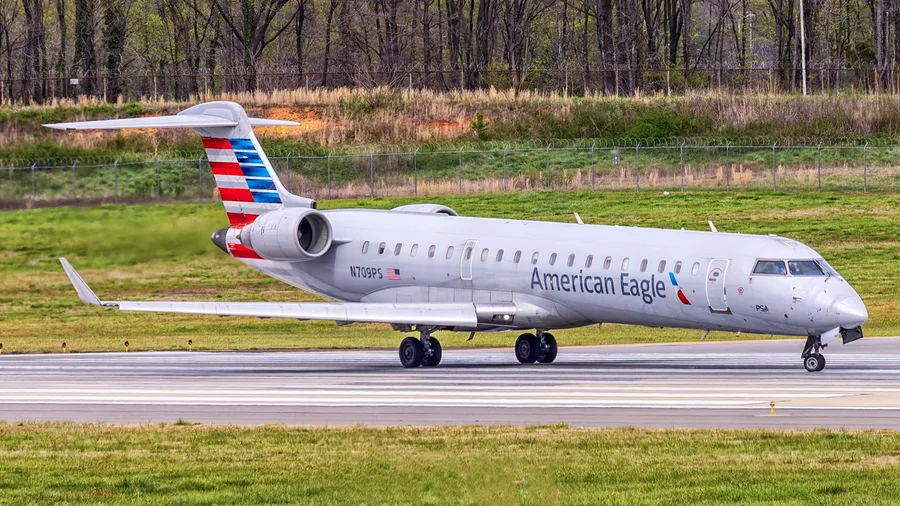
PSA Airlines, operating as American Eagle
What happened
Source: NTSB Final Report (excerpt)American Eagle Flight 5342, a PSA Airlines CRJ700 (N709PS) arriving from Wichita, Kansas, was on final approach to runway 33 at Ronald Reagan Washington National Airport (DCA). A U.S. Army UH-60L Black Hawk helicopter (callsign PAT25, tail number 00-26860), conducting a night-vision-goggle training and evaluation flight along published Helicopter Route 4, was transiting the area at an altitude that placed it in conflict with the approach path. The two aircraft collided over the Potomac River; both were destroyed, and there were no survivors among the 64 people aboard the airplane and the 3 aboard the helicopter.
Why it happened
Source: NTSB Final Report"The National Transportation Safety Board determines that the probable cause(s) of this accident to be: The Federal Aviation Administration's (FAA) placement of a helicopter route in close proximity to a runway approach path; their failure to regularly review and evaluate helicopter routes and available data, and their failure to act on recommendations to mitigate the risk of a midair collision near Ronald Reagan Washington National Airport (DCA); as well as the air traffic system's overreliance on visual separation in order to promote efficient traffic flow without consideration for the limitations of the see-and-avoid concept. Also causal was the lack of effective pilot-applied visual separation by the helicopter crew, which resulted in a midair collision. Additional causal factors were the tower team's loss of situation awareness and degraded performance due to the high workload of the combined helicopter and local control positions and the absence of a risk assessment process to identify and mitigate real-time operational risk factors, which resulted in misprioritization of duties, inadequate traffic advisories, and the lack of safety alerts to both flight crews. Also causal was the Army's failure to ensure pilots were aware of the effects of error tolerances on barometric altimeters in their helicopters, which resulted in the crew flying above the maximum published helicopter route altitude. Contributing factors include: (1) the limitations of the traffic awareness and collision alerting systems on both aircraft, which precluded effective alerting of the impending collision to the flight crews; (2) an unsustainable airport arrival rate, increasing traffic volume with a changing fleet mix, and airline scheduling practices at DCA, which regularly strained the DCA air traffic control tower workforce and degraded safety over time; (3) the Army's lack of a fully implemented safety management system, which should have identified and addressed hazards associated with altitude exceedances on the Washington, DC, helicopter routes; (4) the FAA's failure across multiple organizations to implement previous NTSB recommendations, including Automatic Dependent Surveillance-Broadcast In, and to follow and fully integrate its established safety management system, which should have led to several organizational and operational changes based on previously identified risks that were known to management; and (5) the absence of effective data sharing and analysis among the FAA, aircraft operators, and other relevant organizations."
- FAA's placement of a helicopter route in close proximity to a DCA runway approach path
- FAA's failure to review helicopter-route risk data or act on prior recommendations to mitigate midair-collision risk near DCA
- Air traffic system's overreliance on visual separation ("see-and-avoid") without accounting for its limitations
- Helicopter crew's ineffective visual separation from the approaching airliner
- DCA tower's loss of situational awareness under a high-workload, combined helicopter/local-control position
- No real-time risk-assessment process at the tower to flag the developing conflict
- Army's failure to train pilots on barometric-altimeter error tolerances, allowing flight above the published helicopter-route altitude
- Limitations of both aircraft's traffic-awareness/collision-alerting systems
- Unsustainable DCA arrival rate and air traffic control staffing strain
Photos & media (1)
Reference photos of the two accident aircraft, pre-accident (Wikimedia Commons)
American Eagle Flight 5342, a PSA Airlines CRJ700 (N709PS) arriving from Wichita, Kansas, was on final approach to runway 33 at Ronald Reagan Washington National Airport (DCA). A U.S. Army UH-60L Black Hawk helicopter (callsign PAT25, tail number 00-26860), conducting a night-vision-goggle training and evaluation flight along published Helicopter Route 4, was transiting the area at an altitude that placed it in conflict with the approach path. The two aircraft collided over the Potomac River; both were destroyed, and there were no survivors among the 64 people aboard the airplane and the 3 aboard the helicopter.
"The National Transportation Safety Board determines that the probable cause(s) of this accident to be: The Federal Aviation Administration's (FAA) placement of a helicopter route in close proximity to a runway approach path; their failure to regularly review and evaluate helicopter routes and available data, and their failure to act on recommendations to mitigate the risk of a midair collision near Ronald Reagan Washington National Airport (DCA); as well as the air traffic system's overreliance on visual separation in order to promote efficient traffic flow without consideration for the limitations of the see-and-avoid concept. Also causal was the lack of effective pilot-applied visual separation by the helicopter crew, which resulted in a midair collision. Additional causal factors were the tower team's loss of situation awareness and degraded performance due to the high workload of the combined helicopter and local control positions and the absence of a risk assessment process to identify and mitigate real-time operational risk factors, which resulted in misprioritization of duties, inadequate traffic advisories, and the lack of safety alerts to both flight crews. Also causal was the Army's failure to ensure pilots were aware of the effects of error tolerances on barometric altimeters in their helicopters, which resulted in the crew flying above the maximum published helicopter route altitude. Contributing factors include: (1) the limitations of the traffic awareness and collision alerting systems on both aircraft, which precluded effective alerting of the impending collision to the flight crews; (2) an unsustainable airport arrival rate, increasing traffic volume with a changing fleet mix, and airline scheduling practices at DCA, which regularly strained the DCA air traffic control tower workforce and degraded safety over time; (3) the Army's lack of a fully implemented safety management system, which should have identified and addressed hazards associated with altitude exceedances on the Washington, DC, helicopter routes; (4) the FAA's failure across multiple organizations to implement previous NTSB recommendations, including Automatic Dependent Surveillance-Broadcast In, and to follow and fully integrate its established safety management system, which should have led to several organizational and operational changes based on previously identified risks that were known to management; and (5) the absence of effective data sharing and analysis among the FAA, aircraft operators, and other relevant organizations."
- FAA's placement of a helicopter route in close proximity to a DCA runway approach path
- FAA's failure to review helicopter-route risk data or act on prior recommendations to mitigate midair-collision risk near DCA
- Air traffic system's overreliance on visual separation ("see-and-avoid") without accounting for its limitations
- Helicopter crew's ineffective visual separation from the approaching airliner
- DCA tower's loss of situational awareness under a high-workload, combined helicopter/local-control position
- No real-time risk-assessment process at the tower to flag the developing conflict
- Army's failure to train pilots on barometric-altimeter error tolerances, allowing flight above the published helicopter-route altitude
- Limitations of both aircraft's traffic-awareness/collision-alerting systems
- Unsustainable DCA arrival rate and air traffic control staffing strain